Leveraging AI research to tackle harmful online abuse faced by athletes
What Would You Fight For? is a University-wide campaign to highlight work that highlights Notre Dame’s Catholic Mission, values, and addresses societal challenges to create meaningful impact.
The fight against online abuse in sports is one such effort. Through the Data, AI, and Computing (DAC) Initiative, researchers use artificial intelligence to investigate patterns of abuse in college sports and develop more accurate detection methods.
The Challenge: Online abuse is harming athletes
Online abuse consists of harmful behaviors such as harassment, humiliation, threats, discrimination, and intimidation through digital platforms. In sports, athletes, coaches, officials, and others are at risk of experiencing abuse targeting their identity or performance, often intensified by their public visibility.
Online abuse can impact the mental health and well-being of those affected, ultimately influencing their confidence, performance, and participation in sports.
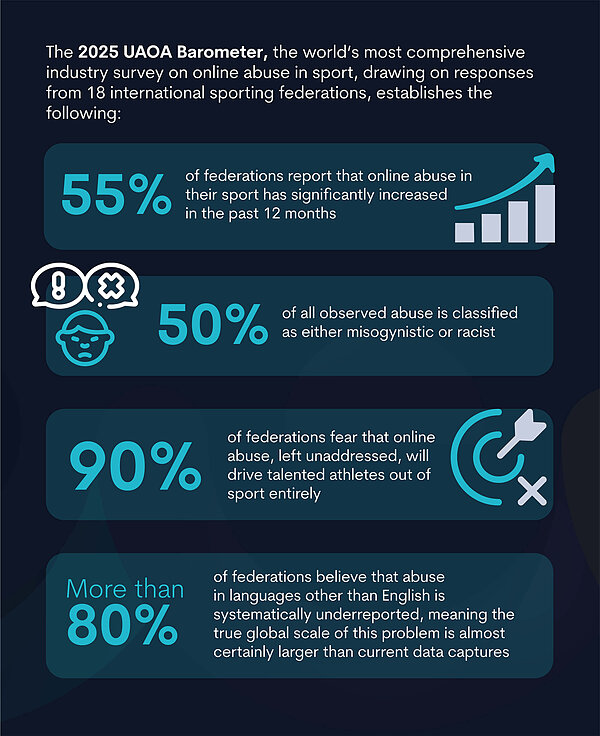
The 2025 United Against Online Abuse (UAOA) Barometer, surveyed 18 international sports federations to examine the scale of online abuse, the types of harmful behaviour reported, and the challenges sports organizations face in addressing it. The findings reveal several concerning trends.
These findings underscore the need for more comprehensive data-driven research on how online abuse affects people across different sports and communities.
Understanding Online Abuse through AI
Researchers within the Data, AI, and Computing (DAC) Initiative are investigating how online abuse emerges, evolves, and targets individuals in college sports. Their work combines large-scale analysis of social media conversations with the development of AI methods to identify harmful content, understand who is being targeted, and improve the reliability and efficiency of automated detection.
Explore the research projects below to learn how these approaches advance our understanding of online abuse and contribute to safer digital environments in sports.
Mapping Online Abuse in College Basketball
How does online abuse targeting players change throughout a game, a season, or an athlete's career?
Using AI, this project analyzes more than 56,000 fan comments about players on social media from three NCAA Division I seasons of men’s and women’s basketball. An AI model identifies abusive comments and their topics, which are then linked to game events, player performance, and each player’s career.
The research examines when abusive comments emerge, how they change over a game, a season, and a career, and which aspects of athletes’ lives, on and off the court, become targets.
Knowing when this abuse rises can help universities, athletic departments, and platforms anticipate it and support student-athletes before it reaches them.
Improving AI Detection of Targeted Online Abuse
Detecting online abuse requires more than identifying offensive words. People may disguise harmful messages to evade content moderation, use indirect references, or mention several individuals in a single comment. These complexities make it difficult for AI systems to identify who is being targeted and which statements constitute abuse.
This project introduces Target–Evidence Alignment Representation (TEAR), an AI training approach designed to improve the detection of targeted online abuse. TEAR trains models to identify who is being targeted, locate harmful statements, and connect those statements to the intended person or group using supporting textual evidence.
This ongoing research aims to make automated abuse detection more accurate and reliable, helping organizations identify harmful content and make timely decisions.
Developing More Efficient AI for Online Abuse Detection
Large AI models can identify abusive content and its intended targets, but their computational demands can limit their use in applications that continuously monitor online conversations. Smaller models offer faster, more affordable alternatives, although they may struggle to achieve the same accuracy.
This project investigates Trust-Aware Residual Learning (TARL), an approach that transfers knowledge from larger AI models to smaller, more efficient systems. TARL evaluates the reliability of the information being transferred, helping smaller models learn to distinguish abuse, criticism, and praise directed at different individuals while reducing the risk of reproducing errors.
The research aims to develop faster, more reliable abuse detection systems that require fewer computational resources, supporting large-scale monitoring and more timely identification of harmful content in sports communities.
Advancing Research Through Collaboration
The United Against Online Abuse (UAOA) initiative, founded in 2023 by the Fédération Internationale de l'Automobile (FIA), is a global coalition of more than 75 governments, sports organizations, researchers, and technology platforms working to create safer digital spaces in sport.
Through a multi-year research partnership with UAOA, the University of Notre Dame is expanding research on online abuse in sport, contributing new evidence to inform prevention strategies, institutional responses, and educational initiatives.
U.S. College Student-Athlete Survey
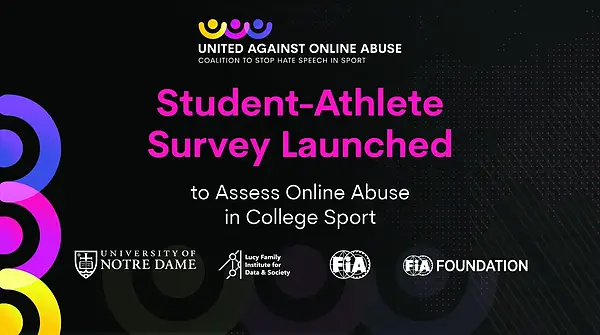
Launched in spring 2026, the U.S. College Student-Athlete Survey is a collaborative research initiative between the University of Notre Dame and the FIA's United Against Online Abuse campaign, supported by the FIA Foundation.
The survey gathers student-athletes' experiences and perspectives to assess the prevalence, nature, and impact of online abuse in college sports, contributing new evidence to better understand the challenges athletes face in digital environments.
The survey is available here and can be completed anonymously by current and former college athletes.
Translating Research Into Educational Resources
Research also informs the development of educational resources and practical tools to prevent and address online abuse in sport. Through its collaboration with UAOA, Notre Dame contributes research, educational content, and technical expertise to help athletes, sports organisations, and other members of the sports community recognise harmful behaviours, understand their impact, and respond effectively. This work connects research with practical applications, strengthening digital safety skills and helping sports organisations move from awareness to readiness to act.
UAOA Workshop Handbook
United Against Online Abuse in Sport: Educational Workshop Toolkit
The UAOA Workshop Handbook is an educational resource designed to guide facilitators in delivering workshops on online abuse in sport. The workshops aim to raise awareness, deepen understanding of online abuse, and equip participants with the knowledge and skills to respond effectively.
The handbook was developed in collaboration with the University of Notre Dame. Building on UAOA's existing workshop materials, Notre Dame conducted research to establish its evidence-based foundation and developed the educational content and activities.
By making this resource freely available, UAOA provides organizations, communities, and individuals around the world with access to education on online abuse, supporting coordinated efforts to address online abuse in sport.
Research Team & Collaborators
This work brings together researchers and collaborators from the University of Notre Dame and United Against Online Abuse (UAOA), combining expertise in artificial intelligence, online abuse research, education, and sports safeguarding.
University of Notre Dame
Nitesh Chawla – Lucy Family Director for Data & AI Academic Strategy; Director, Data, AI & Computing Initiative; Founding Director, Lucy Family Institute for Data and Society; Frank M. Freimann Professor, Department of Computer Science and Engineering
Yessica Herrera – Research Scientist, Data, AI and Computing Initiative
Jessica Young – Senior Data Scientist, Lucy Family Institute for Data & Society
Sugana Chawla – Learning Advisor; Associate Professor of the Practice; Director of Data Science Education & iTREDS Program
Alex Thomas – Strategic Program Manager, Data, AI, and Computing Initiative
Miguel Mota Cruz – Research Associate, Lucy Family Institute for Data & Society
Shubham Gupta – Postdoctoral Research Associate, Data, AI, and Computing Initiative
Nandini Saini – Postdoctoral Research Associate, Data, AI, and Computing Initiative